
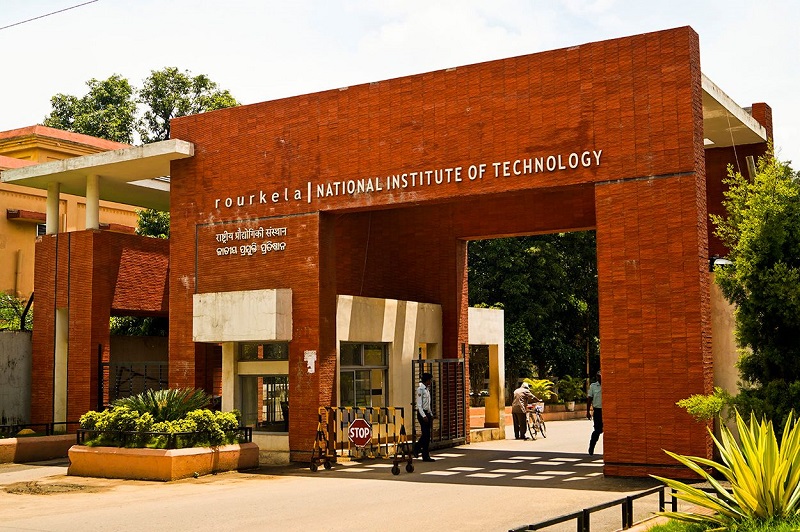
India's biggest university,
National Institute Of Technology Rourkela


Benefit From Our Online
Learning Expertise Earn Professional
To become an internationally acclaimed institution of higher learning that will serve as a source of knowledge and expertise for the society couple of triazole-tethered simple colorimetric, electrochemical and fluorescent chemosensors, based on ferrocene-naphthalene conjugates, C24H21ON3Fe (1) and C38H32O2N6Fe (2), have been designed and synthesized.
Our Mission
The binding incident of both the receptors can be established either from a striking shift in redox potential (1: ΔE1/2 = 76 mV and 2: ΔE1/2 = 43 mV for Hg2+) or from a highly visual output response (colorimetric) for Hg2+ cation.
Our Vision
To become a world-class institution recognized for academic excellence, innovation, and meaningful contribution to society.
About National Institute Of Technology Rourkela
To become an internationally acclaimed institution of higher learning that will serve as a source of knowledge and expertise for the society couple of triazole-tethered simple colorimetric, electrochemical and fluorescent chemosensors, based on ferrocene-naphthalene conjugates, C24H21ON3Fe (1) and C38H32O2N6Fe (2), have been designed and synthesized.
The interactions of 1 and 2 with several metal ions have been investigated systematically which show their strong binding affinity towards Hg2+ ion selectively.
The binding incident of both the receptors can be established either from a striking shift in redox potential (1: ΔE1/2 = 76 mV and 2: ΔE1/2 = 43 mV for Hg2+) or from a highly visual output response (colorimetric) for Hg2+ cation.
The limit of detection with Hg2+ cation was found as low as 2.6 parts per billion (ppb) and 4.5 ppb for 1 and 2 respectively, which is well below of the maximum level of Hg2+ cation in drinking water defined by EPA guidelines.
Furthermore, the sensors exhibit good sensitivity and selectivity for Hg2+ cation on paper-made test kits and on supported solid silica in aqueous environment.
The probable binding modes of these receptors with Hg2+ have also been suggested on the basis of the 1H NMR titration, ESI-MS and computational (DFT) studies along with electrochemical and spectro-photochemical data. More in Sensors & Actuators B: Chemical, 240 (2017) 640–650. (List of Research)
Browse Colleges
Search all colleges across India
Explorearrow_forwardTop Universities
Discover top ranked universities
Explorearrow_forwardTop Courses
Find the right course for you
Explorearrow_forwardFree Counselling
Get expert admission guidance
Explorearrow_forward